RadioRandom.net — Frequencies That Become Time
Everything begins with music — with the invisible waves, flows and frequencies that have echoed across the universe since the dawn of time. Radio was humanity’s first cosmic instrument, born from vibrations traveling through space. From those same primordial signals emerges a new logic: a human time system capable of connecting worlds. Radio Random transforms cosmic resonance into temporal meaning.
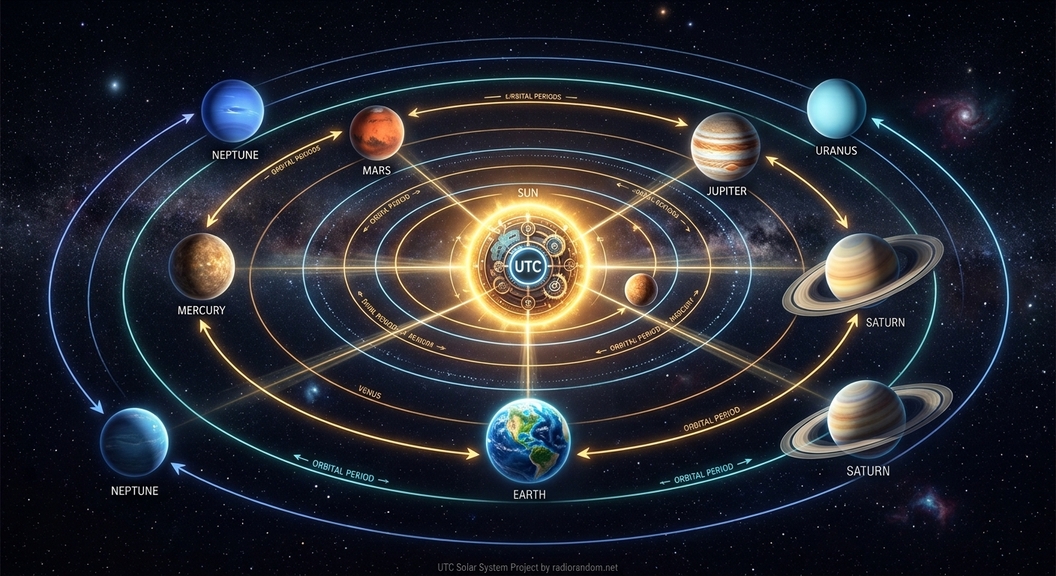
Radio Random Planet Time: The First Human Time System for the Solar System
Humanity is preparing to live predominantly in space, and in the upcoming orbital stations—which will surely be the outposts before, if ever possible one day, colonizing planets like Mars. But orbital stations will definitely host human beings first; however, no one has ever answered a simple question: What time is it on another planet, for humans?
Not in an astronomical sense. Not in a robotic sense. Not with Martian sols, strange meridians, or mission-specific clocks.
But in ahumansense.
Radio Random Planet Time (RRPT) UPT ( universal Planet Time ) is thefirst human time system ever createdfor interplanetary life. It keeps Earth-based seconds, minutes, and hours, while allowing each planet to have its own natural time flow.
UPT is not a time zone. Not a planetary calendar. Not an astronomical experiment. It is ahuman-centric temporal standarddesigned for communication between worlds.
A Practical Example
An officer on a Venus orbital station wants to call his son on the Moon:
UPT answers clearly:
- Earth → 10:12
- Moon → 07:54
- Venus → 03:41
Why This Will Become a Standard
UPT is simple, physically coherent, and built for humans — not robots. When humanity expands into space, this system will be needed.
The Mental Journey
Radio Random also includes musical frequencies that let people travel mentally through cosmic time, while Earth remains the only planet capable of hosting our nearly perfect biological system.
RRPT UPT White Paper
Executive Summary
Radio Random Planet Time (RRPT) ( UPT ) introduces a universal human time standard for interplanetary communication and life. It is based on Universal UTC Time (UUT) and modulated by planetary drift factors (PDFs). RRPT keeps human time units intact while allowing each planet to have its own natural temporal rhythm.
1. Introduction
As humanity prepares to expand across the Solar System, the need for a unified, human-readable time system becomes essential. Existing planetary time systems are designed for robots, probes, and scientific instruments — not for human life. RRPT solves this by creating a human-centric temporal model that works across planets, moons, orbital stations, and interstellar missions.
2. Universal UTC Time
UPT is the foundation of RRPT. It maintains Earth-based seconds, minutes, and hours as the universal human standard. This ensures psychological stability, cognitive familiarity, and communication clarity across worlds.
3. Planetary Drift Factor (PDF)
Each planet has a unique rotational period. The PDF adjusts the flow of local time without altering human units.
Formula:
PDF = 24h / (Planetary Day Length)
Examples:
- Moon → PDF ≈ 1.00000065
- Mars → PDF ≈ 1.027
- Venus → PDF ≈ 243
- Jupiter → PDF ≈ 0.38
4. Planetary Time Flow (PTF)
PTF defines the local planetary time derived from UPT.
Formula:
PTF = UTC × PDF
This creates readable planetary time for humans, allowing each world to have its own temporal identity.
5. Planetary Communication Sync (PCS)
PCS ensures synchronized communication between planets, accounting for time differences and light‑lag delays. It converts UUT to PTF instantly for both sender and receiver.
6. Human-Centric Time Priority (HCTP)
RRPT ( UPT ) is designed for human life — families, crews, civilians, and future interplanetary societies. It avoids robotic time systems and maintains human cognitive comfort.
7. Planetary Identity Clock (PIC)
Each planet receives a unique temporal identity based on its natural rotational rhythm. This creates cultural and operational coherence for future colonies.
8. Interplanetary Life Sync (ILS)
ILS enables natural communication between humans living on different worlds. It ensures that time references are always human-readable and context-aware.
9. Interstellar Extension (ISE)
RRPT scales beyond the Solar System using the same logic. PDFs can be applied to exoplanets, and UTC can be synchronized via quantum or laser communication networks.
10. RRPT ( Radio Random Planet Time ) Moon Station First Architecture
The Lunar Station, with lunar time calculated based on UTC, is the starting point for the future space-time that humanity will have to face.
11. Use Case
A Venus officer calls the Moon. RRPT provides synchronized human-readable time instantly:
- Earth → 10:12
- Moon → 07:54
- Venus → 03:41
12. Conclusion
RRPT UPT is the first human time system designed for interplanetary life. It is simple, coherent, scalable, and destined to become a future standard. We hope that engineers and scientists at NASA and other space agencies will find it a convenient landing solution, thanks to its simplicity and adaptability—both for rovers and for whatever comes next.
RRPT Technical Documentation
1. Purpose of the System
RRPT| UTP ( Universal Planet Time ) defines a human-centric temporal model for interplanetary communication, life, and operations. It ensures that humans can understand time naturally across planets, moons, stations, and spacecraft.
2. Universal UTC Time
UPT is the absolute reference for all conversions. It maintains Earth’s units of time measurement and ensures the global synchronization of the entire known universe.
3. Planetary Drift Factor (PDF)
PDF determines the speed of planetary time relative to UTC. It is calculated using the natural rotational period of each planet.
4. Planetary Time Flow (PTF)
PTF defines the local planetary time derived from UTC × PDF. It creates readable planetary time for humans.
5. Planetary Communication Sync (PCS)
PCS handles interplanetary communication, converting time references instantly and managing light‑lag delays.
6. Human-Centric Time Priority (HCTP)
RRPT | UPT avoids robotic time systems and maintains human cognitive comfort. It ensures that time remains familiar and readable.
7. Planetary Identity Clock
Each planet receives a unique temporal identity based on its natural rotational rhythm. This creates cultural and operational coherence for future colonies.
8. Interplanetary Life Sync
ILS enables natural communication between humans living on different worlds. It ensures that time references are always human-readable and context-aware.
9. Interstellar Extension
RRPT UPT scales beyond the Solar System using the same logic. PDFs can be applied to exoplanets, and UTC can be synchronized via quantum or laser communication networks.
10. Interplanetary Time Panel (UI Specification)
The panel displays:
- UTC (Earth Time)
- UPT Local time of the planets
- PCS Sync Status | each planet present with its own rotation and solar day dynamics.
- Communication Delay (Light‑Lag)
12. Conclusion
RRPT | UTC Universal Planet Time is scalable, coherent, human-centric, and ready for future interplanetary life, and of the future orbital stations scattered throughout our solar system that will house humankind. It is the first system of its kind — created here, That’s all.